Il Baule
Il Baule
From the window, the eternal snows of the Alps protect the peaks that divide the Savoy region from the Papal States. Upon my arrival in Rome, I am greeted by Émilie Courtel, an artist from Lille who now lives in Rome and is the mother of two. She hands me the antique key to the studio located on Via del Vantaggio, on the top floor of a building backing onto an interior courtyard. Our first night in Rome is cold and damp. It is January 3, 2021. I say “our” because I am not alone on this journey. I am accompanied by Sébastien, my friend and lover. The roof of the Wicar studio is a kind of plastic skylight that amplifies the slightest noise, in this case the rain, accentuated by its height of about five meters.
The studio is named after Jean-Baptiste Joseph Wicar, a painter and collector from Lille. Upon his death in 1834, he bequeathed the building that would be my studio for a hundred days. When we go out to buy wine and a frozen pizza, my first impression of Rome is familiar: it resembles the colonial cities of Mexico. The narrow streets are worthy of a dystopian scenario, and the city seems to be under siege with armed soldiers posted in front of every palazzo, government building, and church. This vision is intensified by the pandemic we are going through, but this mixture of religious architecture and militia reminds me of the post-war portrait described in Curzio Malaparte’s Skin. The Piazza del Popolo, located a stone’s throw from the studio, is not so different from the squares of Mexican cities, with its cobblestones resembling corn kernels. Passersby strut around in outfits that could be found on their bourgeois Latin American counterparts.
A small man crosses the square wearing a pair of tiny round black glasses.
He resembles Pieter van Gent, the 16th-century historical figure whom I once transformed into a ghost of Mexican and European history, and who earned me selection as a winner for the city of Lille. I always imagined Pieter wearing dark glasses similar to those worn by religious figures in 17th-century Baroque paintings, supposedly to protect them from the emptiness and banality of the world and the flesh. Pieter, Pierre, or Pedro de Gante never knew Rome, but in exchange, he witnessed the construction of its mirror image across the Atlantic: Mexico City.
Rome wasn’t built in a day, and neither was the construction of the colonial imagination linked to America. European evangelists and colonists took the city of Mexico as Rome’s mirror image on the American continent, allowing them to draw historical, cultural, and iconographic parallels in order to establish profound meanings that completed colonization. This parallel, which made Rome and Mexico City the cradles of ancient and pagan cultures (Etruscan, Aztec, Greek, Teotihuacan, etc.), was also a powerful argument for establishing Mexico City as the Christian capital of the New World. We could also mention the founding myths that gild the fame of these two cities: on the one hand, Romulus and Remus, and on the other, the eagle eating the snake above a prickly pear tree, announcing the exact location of the founding of Mexico City. The latter is a surviving image that still appears on coins and on the green, white, and red flag.
It is therefore no coincidence that the cité éternelle reminds me of home, and it would be wrong to say that Mexico resembles Rome without thinking of all that is of Mexican origin in Italian culture, to the point of becoming part of the idealized image of this eternal Italy. For example, unlike Spanish or French aristocrats, Italian elites were the first in European history to adopt the consumption of the tomato, or tomatl, its real name in Nahuatl-Aztec. The same is true of products of Mesoamerican-Mexican origin which, as Barthes says, nevertheless constitute “Italianness”: zucchini, zucchini flowers, peppers, prickly pears (whose name, even in its Italian version, fico d’india, never ceases to strike me with the symbolic boundary between wild and civilized that it imposes). The colonial process, still ongoing, confiscates symbols and signifiers, from Mexico and all other territories colonized by Europe. This is visible even in the rain-soaked packaging of Buitoni pizza.
We spent our first week exploring Rome on foot and waiting for a trunk to arrive from the Visual Arts Department in Lille. This metal trunk was supposed to contain art supplies. Since I am a video and text artist, my trunk was almost empty. When it was delivered, it seemed to me to be a relic of the era when French artists used to stay in Rome to seek inspiration.
In the Wicar studio, we are close to the Via del Corso and the Palazzo Mancini, the building where the Villa Medici was once located before its permanent relocation to the nearby Pincio hill. Since 1868, the Wicar studio has seen a succession of residents, almost without interruption, and its premises have since been managed by the Pieux Établissements français à Rome, a congregation of French people, mostly clergy, presided over by the French ambassador. The foundation comprises five churches: La Trinité-des-Monts, on the Pincio hill; Saint-Louis-des-Français, which houses Caravaggio paintings and is popular with French Catholic expatriate communities, especially on Sundays; Saint-Yves-des-Bretons, closed to the public; Saint-Claude-des-Bourguignons de Franche-Comté; and finally, Saint-Nicolas-des-Lorrains, located next to Piazza Navona and home to superb marble altarpieces.
“Your Excellency, Rector of Saint-Louis-des-Français in Rome, thank you for your attention to this letter of introduction. Please believe in the sincerity of my artistic project. Yours sincerely, Vir Andres Hera.” I spoke with Émilie several times about my desire to film the interior of a Roman church, and it was with these lines that I made my first approach to the Pious Establishment. This obsession with religious trinkets, as Sébastien calls them, dates back to my earliest memories at home in Yauhquemehcan, where, from five o’clock in the morning, you can hear the hubbub of mass broadcast through dilapidated loudspeakers throughout the village, particularly noticeable at my mother’s house, which is ten meters from the church.
My relationship with the Judeo-Christian tradition and places of worship is unclear, consisting of scattered fragments that I experience through opaque stained glass windows, through the shadows and historical conflicts that this has produced in individuals in a country like mine. Yet when I walk through the doors of a church, I am not a stranger. Having been raised Catholic, these places are a kind of home. I wander through their alcoves, observing the old, unvarnished gilded woodwork, the corridors of the monasteries where I lived, and finally I see myself as a child wanting to become a priest, then a nun. I have made this digression not to justify my love of Baroque aesthetics, but to contextualize my approach to this encounter with religious pomp during my stay in Rome. As a mixed-race and queer individual, I experience this stay in Rome as an initiatory journey inside the whale, and an opportunity to disturb the beast from within. Or, as my friend, the director of Shirley Bruno, wrote in her film “An excavation of us” about the Haitian revolutionary uprisings: “We burned the plantations because it was our duty to burn them, because we had built them, and because that was the price of freedom.”
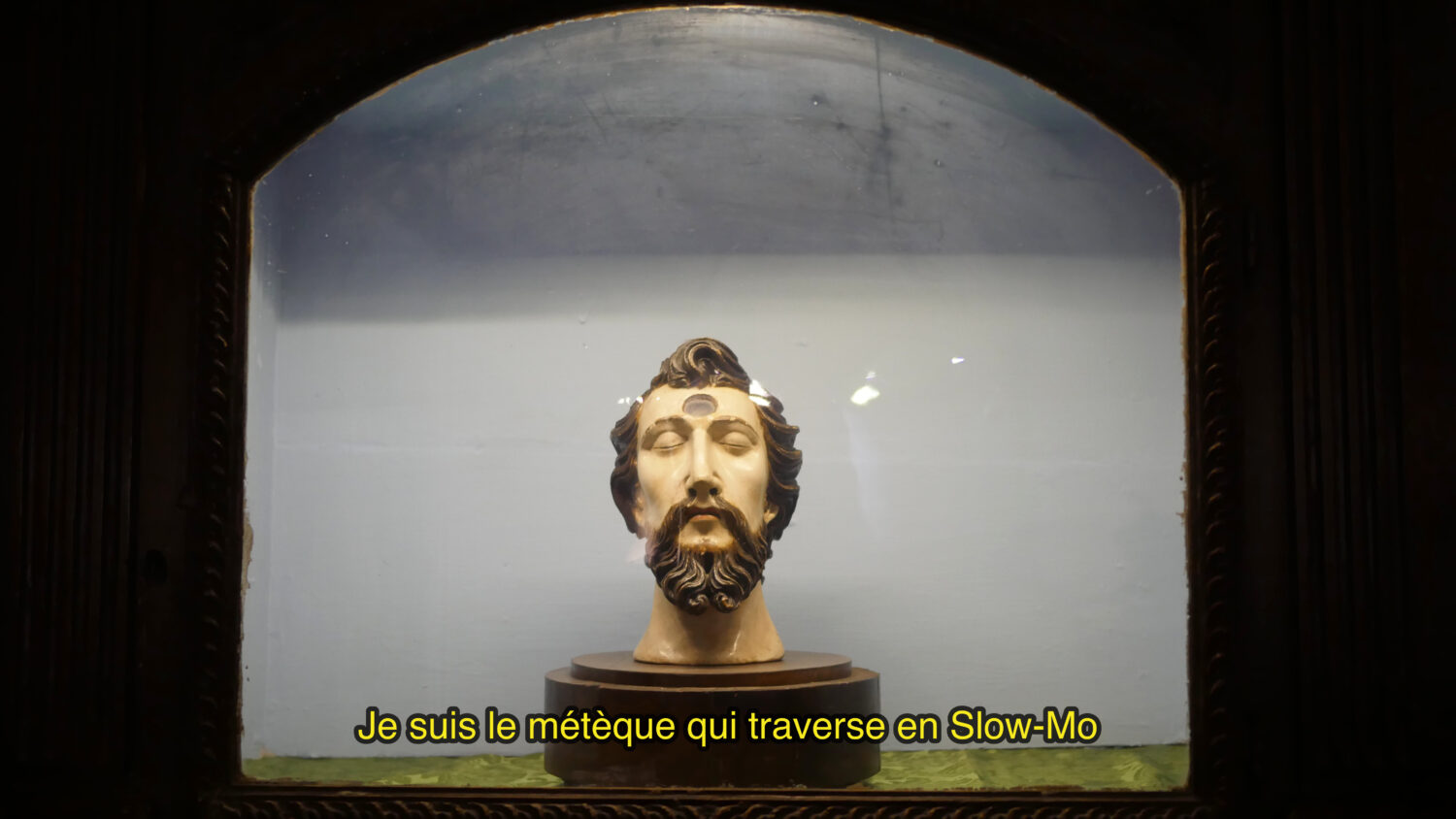
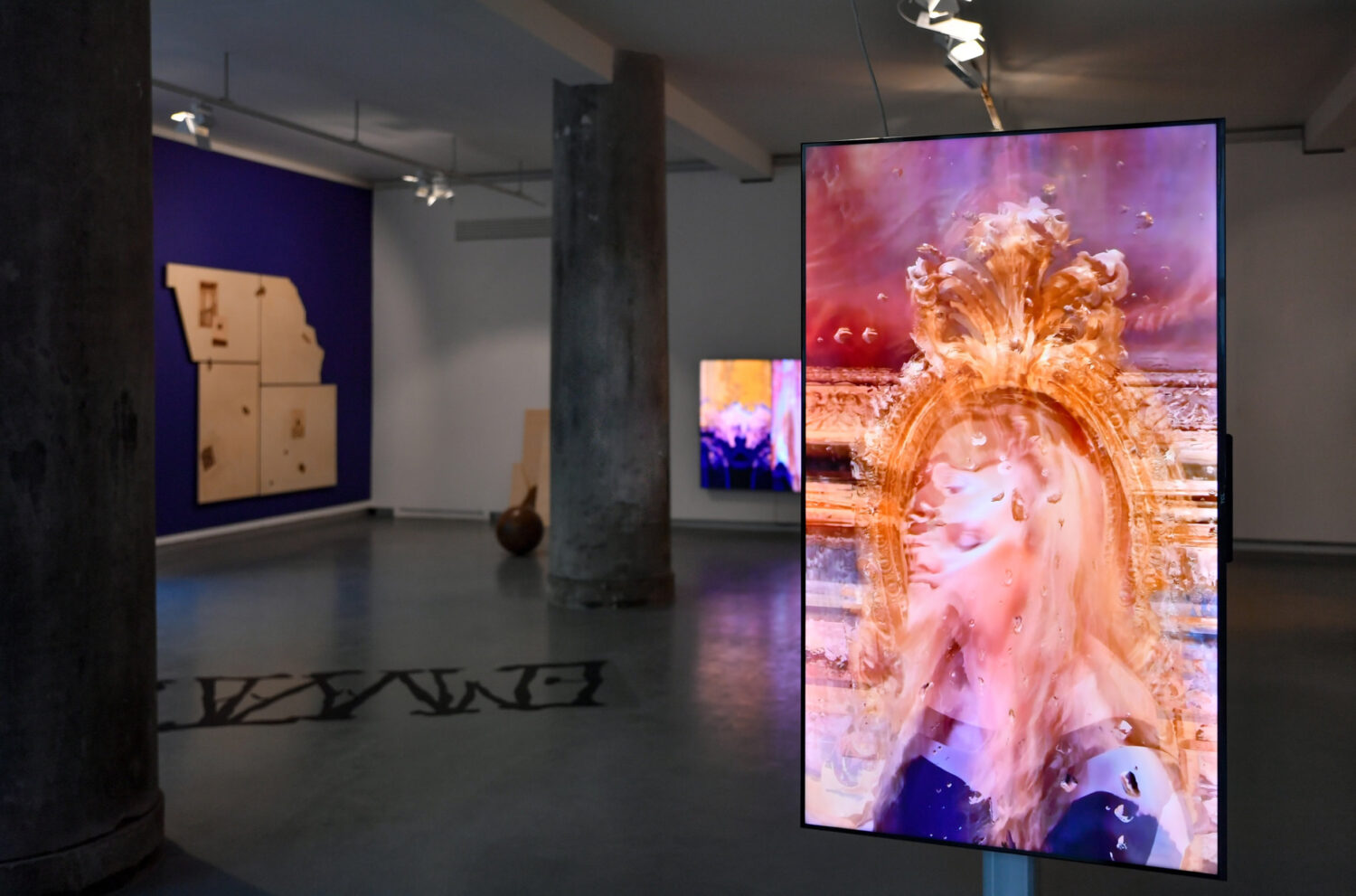
I explained to Brother Christophe-Marie, head of Saint-Nicolas-des-Lorrains, my desire to film inside the church, poems inspired by biblical characters, particularly stories of same-sex friendships, which for me evoke possible types of queer relationships. These characters include Jonathan and David, who had a kind of bromance in pre-Messianic times. I also wrote lines evoking the great classic Saint Sebastian, as well as haikus in Latin, Italian, English, and French for Naomi and her Moabite daughter-in-law Ruth, a romantic friendship charged with lesbian undertones. and finally, a discovery made in situ, the Madonna di Montevergine, a virgin venerated around the world, protector of the femminielli: an ancestral Neapolitan identity referring to transgender and non-binary people, which immediately evoked the history of muxe identities here in Oaxaca in southern Mexico. The filming unfolded without interference, and with complete freedom regarding the content of my apocryphal poems, which were interpreted by Gaia Riposati, an artist and opera singer who was introduced to me by collectors Mario Pieroni and Dora Stieflmeye.
Nevertheless, I like to imagine that my trunk was filled in advance by hordes of Mexican heart-stealing spirits and cihuateteo, the ghosts of women who died in childbirth in pre-Hispanic times. As I wander through the seven hills of Rome, I show them a little of this city that resembles our own, Mexico-Tenochtitlan, or Mictlan, the land of the dead, as some affectionately call it.
One Wednesday afternoon, after Apolonia Sokol showed me the colonial tapestries based on Francesco Salviati’s designs, I was walking home from the Villa Medici. I found myself in the Piazza di Spagna, where the smells of chile verde, mole, guava, and pineapple wafted from a pot set up in front of the Dior boutique. To my surprise, the influx of ghosts had increased tenfold in just a few days. The ghosts of Mexico were everywhere! They had even called in a tamale vendor.
Vir Andres Hera