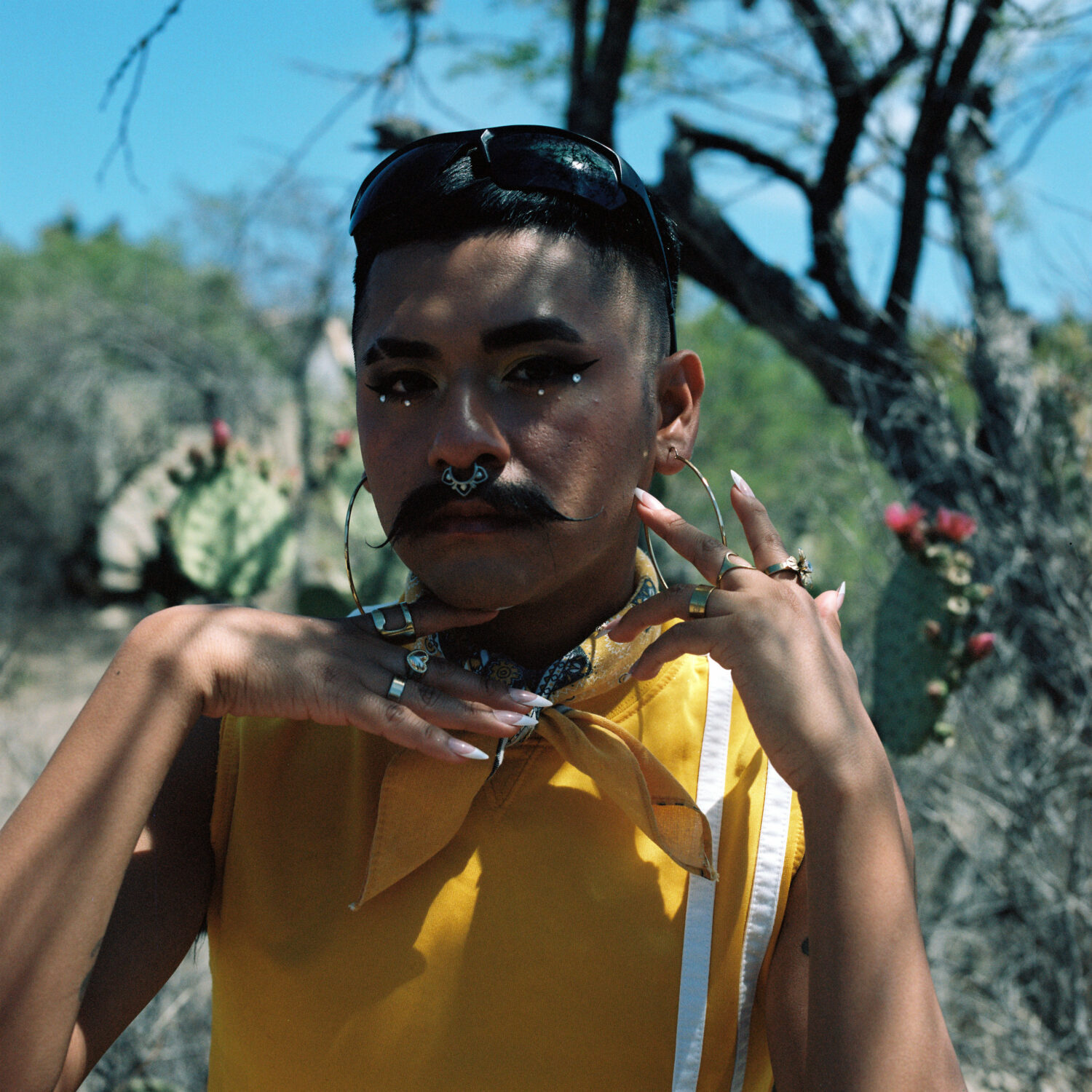
Lu Rose is a London-based writer whose work focuses on moving image and contemporary art. Her writing has appeared in Basta Magazine and publications such as Bleet.
Moving (intimately with) image
2025
Text
Originally published during the exhibition 'Distance, Proximity & Connection' at EUCA Annex & The Writers’ Room, London.
Text by Lu Rose Cunningham featuring a conversation with Vir Andres Hera about 'Step With Me Into The Boundlessness.'
Moving (intimately with) image
2025
Text
Originally published during the exhibition 'Distance, Proximity & Connection' at EUCA Annex & The Writers’ Room, London.
Text by Lu Rose Cunningham featuring a conversation with Vir Andres Hera about 'Step With Me Into The Boundlessness.'
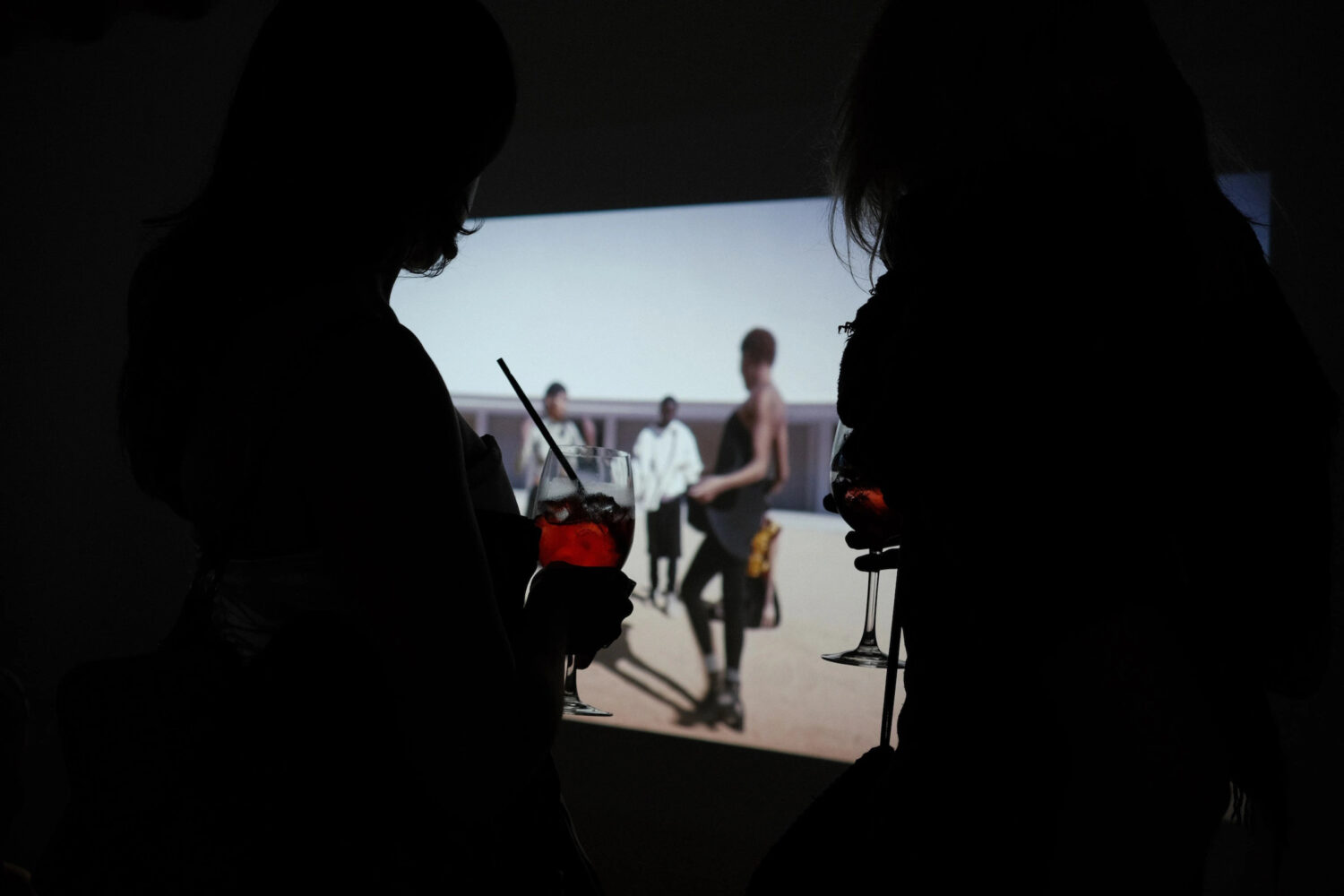
I write this in the weeks following the show Distance, Proximity & Connection » 1 « , held across EUCA Annex in Walthamstow and The Writers’ Room in Islington, with an additional screening event at Holy Trinity Church, Islington. The show, a culmination of moving image works, was curated by French curator Annie Auchere Aguettaz and the founder of EUCA Annex, TC McCormack. A show I had became familiar with – through installation, invigilating, watching, recalling – to then step back from, allowing a time expanse before returning to. A distance to the proximity. […] Within the context of the project, I gravitate towards the films screens of Vir Andres Hera and Ben Rivers, in collaboration with fellow filmmaker Ben Russell.
Distance, Proximity & Connection, https://eucaannex.com/exhibitions-1, November 2024
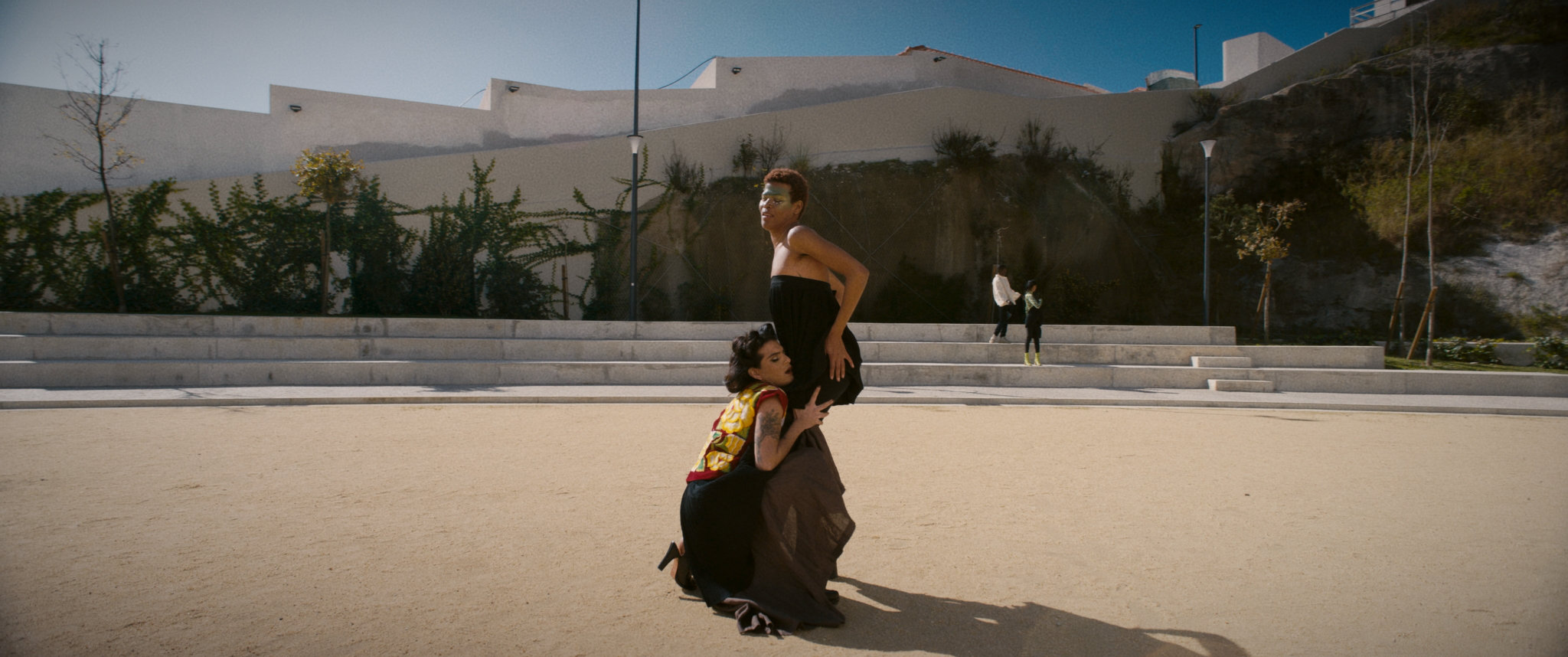
Still from Step With Me Into The Boundlessness, 2023. HD video. Vir Andres Hera.
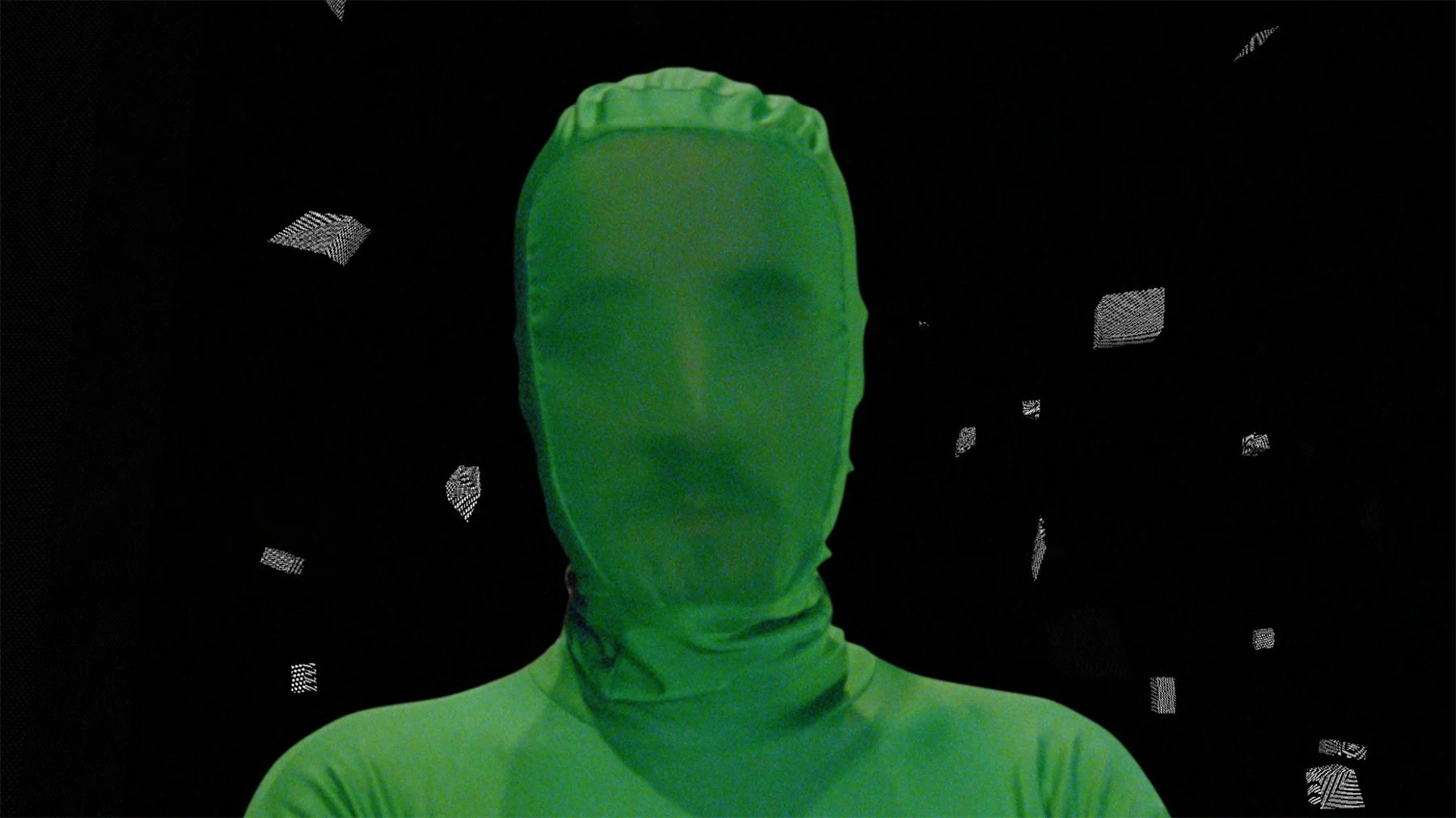
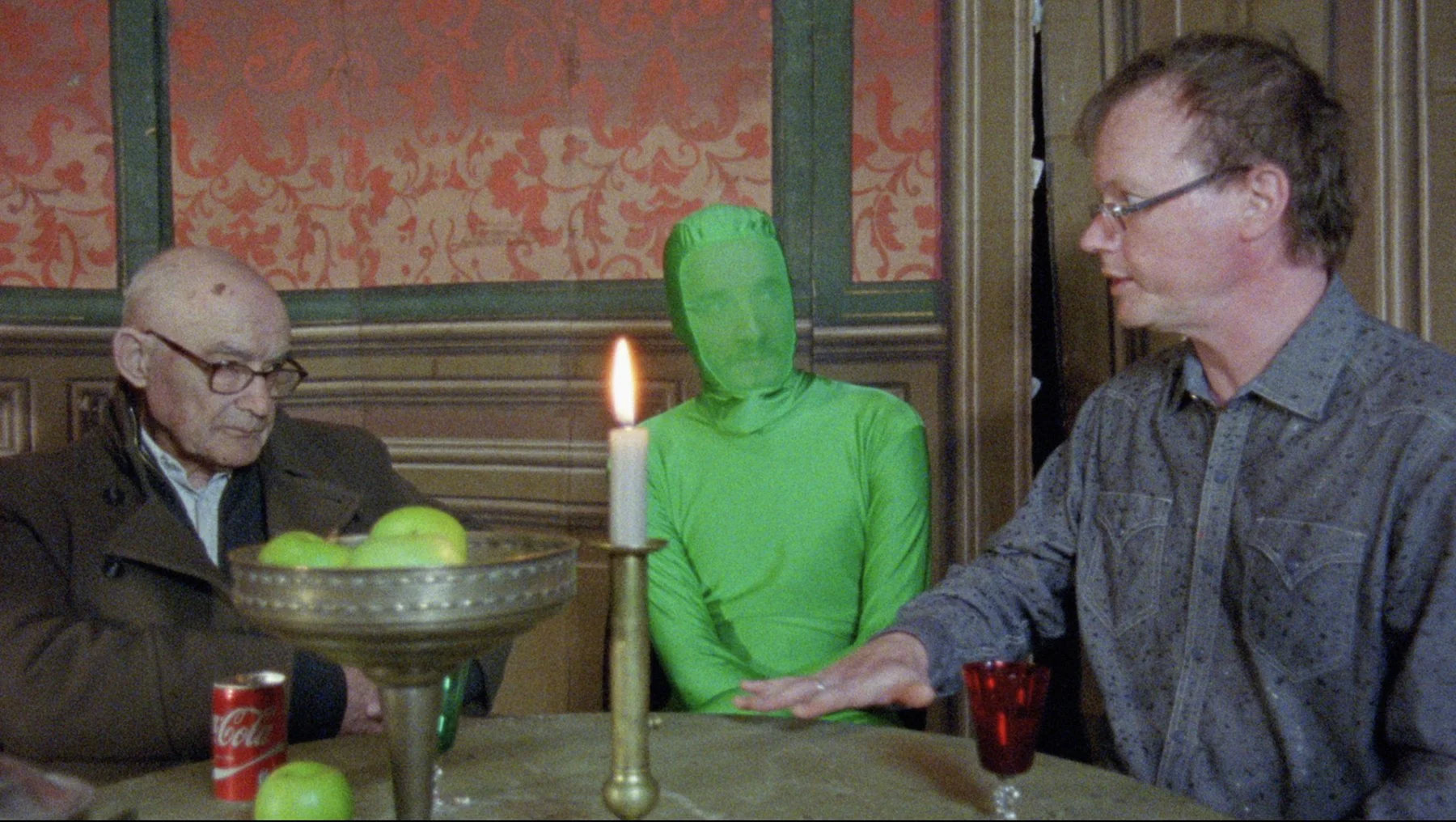
Shown as part of the project’s screening special, I witnessed THE RARE EVENT (2017), co- directed by Ben Rivers and Ben Russell. Spanning 48 minutes, I came to experience a gradual emersion into a meandering, at times an intellectually demanding but also humorous, cosmic piece of fact and fiction. The work opens up to a symposium, ‘a three-day ‘forum of ideas’ with such thinkers, artists and curators as Jean-Luc Nancy, Philippe Pareno, Boris Gruys, Manthia Diawara, Gayatri Spivak and Timothy Morton – takes place in a creaking Parisian recording studio. The group discussed the numerous possibilities of ‘resistance’ (after the title of an exhibition that never took place, a sequel to Jean-François Lyotard’s Les Immatriaux, from 1983). Rivers and Russell take this discussion and go on to create a factual registration of the event discussing art, philosophy and politics, while adding their own creative flair – a man dressed in a green suit is a human ‘green screen’ and a surrogate for philosopher Jean-François Lyotard. He steers us towards an abstract, digital cosmos… a counterpoint to the serious group discussions. In The Rare Event, the notion of symposium shifts from formalised discussion to the supernatural. » 2 «
Meeting Rivers a few weeks later at his studio-home in East London, he shares how him and Ben Russell ‘set themselves rules to follow that opened up their footage to chance, to surrendering total control of what scenes were captured.’ Each day they shot on film for five minutes every hour, no matter where the dialogue was at, the camera on a dolly device, moving around the discussion groups. They would also adjust the height of the camera throughout the day, so that gradually the focus shifted from eye-level to body-level, attention itself as a meandering being, and continually explored modes of perception, of letting these decisions manifest through unexpected moments or phrases – the viewer pulled scene to scene with the roving camera, the dialogue never scripted or foreseen. Thus, the conversation moved with somewhat of a removal, from the entirety of the event, its fragmented form loosing coherent meaning, instead offering a dialogue warped and on the edge of understanding. It was also freeing and animated in this sense – screened was a layered polyphony of communication and interruption, moving with time and space as opposed to rigid scripting, ways of looking, thinking and re-presenting within moving image opened up.
The Rare Event, , accessed December 2024
Still from The Rare Event, 2017. Film by Ben Rivers and Ben Russell.
Rivers continued to expand on this idea of ‘images being concrete but with the potential to be more malleable through such playful encounters.’ This was done further by their addition of a green man
– a figure in a green screen suit – sat among the speakers, creating a futuristic world between the present, future and past. Moving with an otherworldly green man, a walking technological presence among humans, the work undulated between the present moments at the event and a dated graphic realm built of pixelated blocks, crumbling blocks like crumbling classical building blocks. Perhaps the crumbling speech of philosophical thinking. The green man sits or roams quietly throughout, bar the occasional creak of floorboards underfoot as he traverses the rooms in which the event plays out – such creaks making tangible this otherworldly being. Here this unannounced figure seemed closer to the position of the viewer, on the outside of the dialogue, in a resistant ‘no-place’ beyond the dense philosophic discussions. They seem to be questioning, picking up and attempting to compute narratives engaged with, a figure on the edge. The conversations in the film centred magic and opacity – much like that of the man, of the trance-like state he moves in and out of realities, and the roving eye of the camera capturing moments from states of dreaming to intense debate.
Still from The Rare Event, 2017. Film by Ben Rivers and Ben Russell.
The mythic figure of the green man comes to mind, Rivers’ tendencies towards more rural, folkloric depictions slipping in with a sense of warmth and play, of both character and viewer navigating the world and its complexities, its difficulties and trickery. Ben shares how he sees the characters in his works as communities, figures – in the work and in the crew behind the camera – collaborating, moving, evolving, expanding and closing in on, like ever-shifting ‘constellations’. In presenting such peripatetic moving imagery, The Rare Event dedicates more attention to textures and gestures than to the seminar/facts/static nature of the ‘real’ world. Other worldliness severed from the conventions of time, between logic and imagination. The idea of a void – ‘a green-man-shaped infinite void’, the green man as kinetic digital magic, adhering dimensions together. I wonder if this could be a new definition for moving image.
Rivers goes on to share how he’s in the editing stage of a new work, revolving around children, in a realm devoid of adults, and violence. This statement alone feels like myth-making in the context of today’s world. Showing me a clip, there is a burning warmth spreading out, through the colours and expressions of the children at play, simmering through the lens. I want to be inside this film, its warmth, agelessness, its feelings of inquisitive and honest play. Of understanding and learning, passing from place to place, perhaps never with a complete understanding of how time and place function, of why something is happening. This leaning into not-knowing, of opening oneself up to happenings and subjectivities as they come – this carries across into Vir Andres Hera’s work too. Rivers talks of prose writing, ‘each paragraph like a scene’, an act of observance that draws the reader – from page to screen – in at any point, entering at whichever axis the tone is tilted at. We talk of literature that conjures moving accounts of temporality and place, a love for being ‘sucked into different worlds.’ There is a fictioning in Rivers’ imagery too – Ben notes that at present he is reading an increasing amount of fiction, auto-fictive pieces and sci-fi works informing his practice.
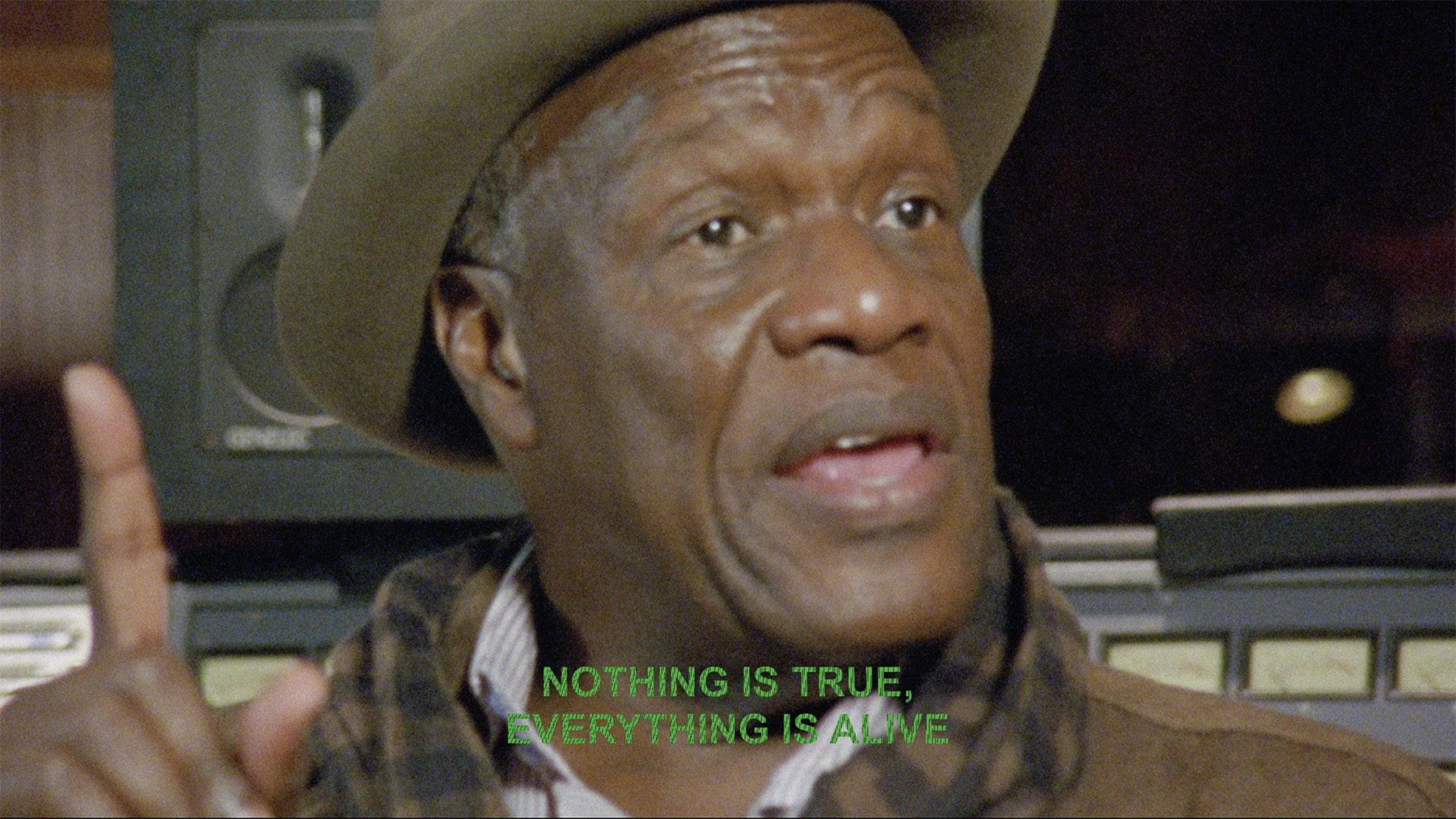
At one point in The Rare Event, the subtitle ‘poetry as closest thing to opacity’ rolls out – human complexity, via works of poetry, of art, is not transparent. Rivers and Russell’s work returns to an understanding of the fragment/poetry/pieces of information, the moving image staged in parts, like poems, as the closest forms to living, to being.
Still from The Rare Event, 2017. Film by Ben Rivers and Ben Russell.
Mirroring the duality of spaces across which the project occurred is the duality of the documentarian and fictional genres – the simultaneous distance/opacity in how information is given, not always offering up everything immediately, and the gradual closeness to a feeling or character that a viewer can experience through proximity, through time spent with a scene or dialogue, a rotational motion around and around subject matter, edging closer. In Rivers’ practice, fiction and fact press against each other, merging into the other, fracturing and coalescing like the collapsing blocks. A side step from reality and a heightened sensitivity to testing ideas out and bending expectations, arguably more adjacent to the lens of a curious child, Rivers and by extension the camera and audience come closer to the world’s multiplicitous rhythms and lore.
I leave reflecting on how the films witnessed recently examine bodies, how bodies relate to the moving image, and how the moving image seeks to articulate and visualise that which is bodily and tied to identities – time, community, myth-making, world-building. I think again of Vir Andres Hera’s piece screened at The Writers’ Room, Step With Me Into The Boundlessness.
Excited to hear more, we call on Zoom – our moving image discussion via moving image – me from London and them from a small tiled kitchen in Lyon, where they are staying to present their new video installation Amoxtli, at the Biennale de Lyon 2024. Normally Vir resides in the mountains near Annecy, where the project’s curator Annie also lives. Within a few minutes of detailing the project to Vir, they express how Ben Rivers was a Visiting Professor at the film school they studied at – Le Fresnoy, Studio National des Arts Contemporains – just after they graduated. I enjoy this small detail, feeling that my pairing of practitioners fits in more ways than one.
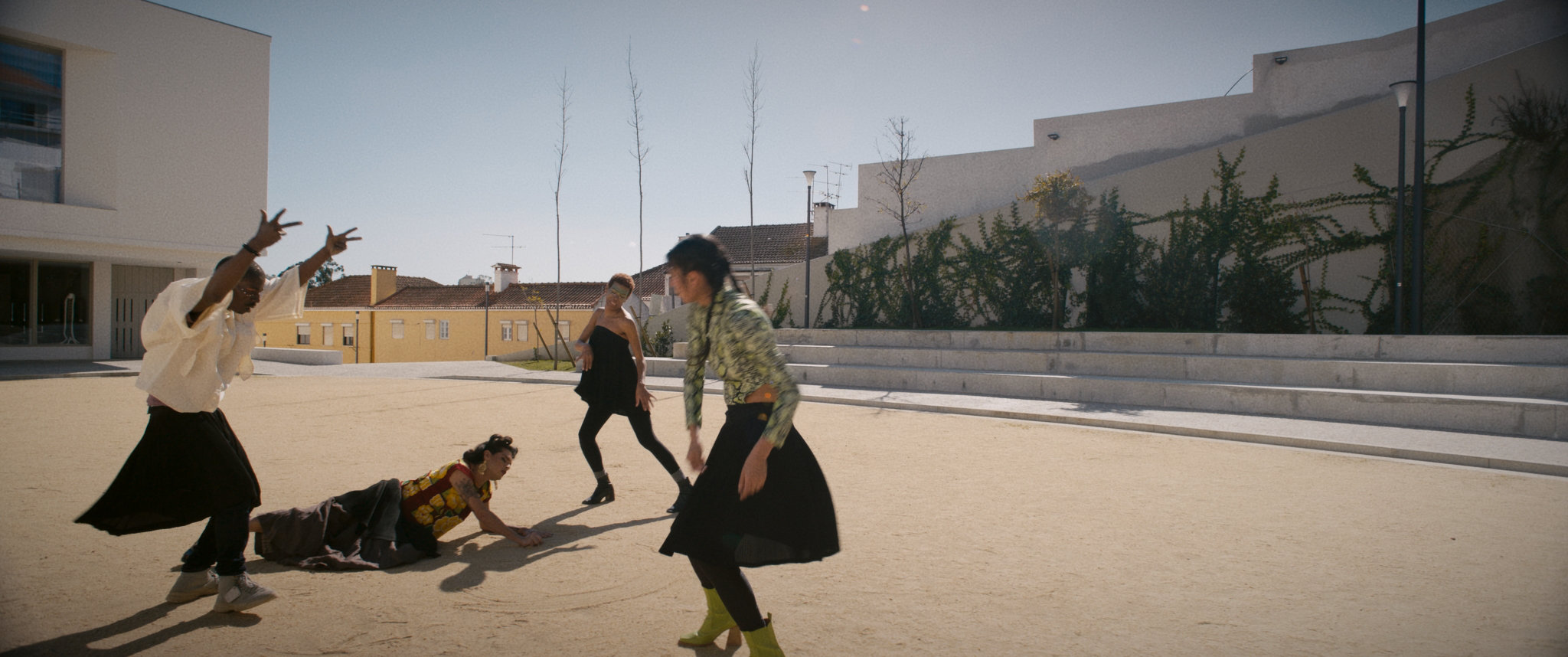
Discussing the work we had shown here in London, it transpires that the section we shared, Step With Me Into The Boundlessness, is part of a larger extensive work – with a future intention to become a trilogy – and that this section was in fact the last chapter – the fifth chapter – of the trilogy’s first part, titled Daftar. Once more, a sense of protraction, feeling a distancing suddenly, a misplacement, in recognising that I had only encountered one segment of a bigger whole. But in regarding this, the notion I had posited of stepping into an ongoing narrative in Vir’s work was concretised. I had indeed arrived late to the party, joining the dancers emerging on screen. I learn later that only two of the four movers were trained dancers, the others a designer and painter respectively – ‘all of them just ran with it and wanted to move with one another.’
Still from Step With Me Into The Boundlessness, 2023. HD video. Vir Andres Hera.
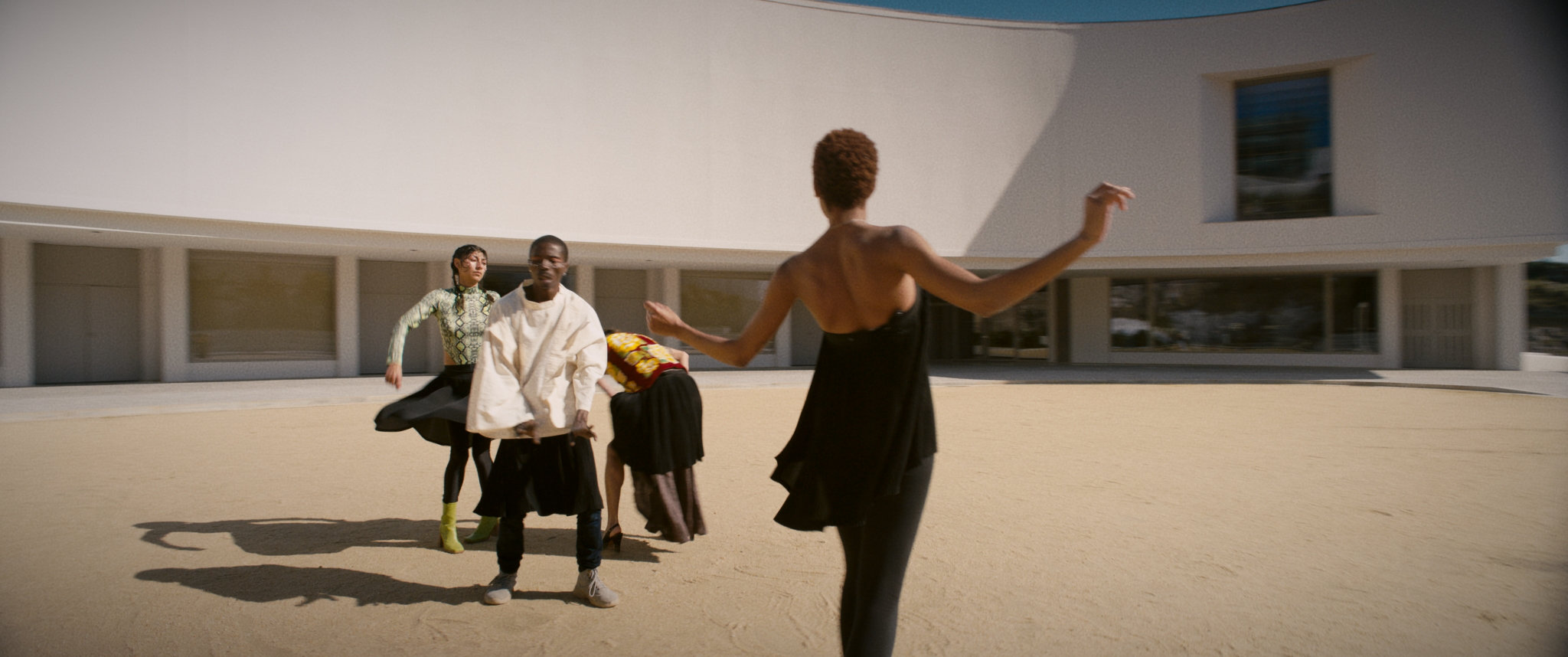
Still from Step With Me Into The Boundlessness, 2023. HD video. Vir Andres Hera.
Vir quickly insists that their works aren’t presented as ‘films’ but rather ‘moving image works’ or ‘video installations’, resisting the polished cinematic production houses and processes, favouring smaller independent projects with narrative and collectivism at the centre. Their works are attempts to exercise memory, to explore queer time and identity, to move with bodily subjectivities and to embody. They share how much they enjoy Mexican literature, such as works by Gloria Anzaldua and Carmen Boullosa, drawn to the richness of history and pain, ritual, the connectivity between people and landscape. They continue, aligning their work with the project’s title – DISTANCE, PROXIMITY & CONNECTION – sharing that when Annie had invited them to show in London, they thought of this excerpt from Daftar, noting its singularity and removal from a fuller body of work – connected but extracted. They embellish on how the work – performative in its choreography and dialogue – wasn’t rehearsed, but stemmed from a determination to create and communicate with one another – Vir as director, with the four performers and production team. They share how at one point in the excerpt, the viewer can glimpse them briefly running in the reflection of the window of the building performed in front of, as the camera is rapidly rotating around the dancers in the shot.
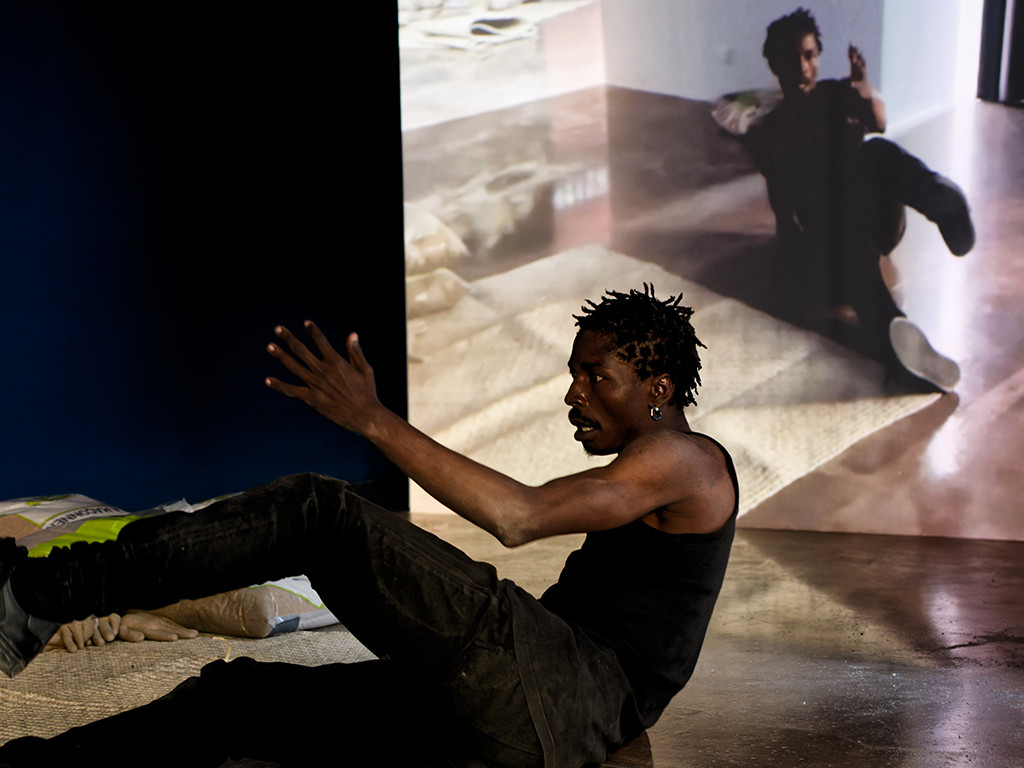
‘I was running behind the camera person, indicating how to move to the performers, move this way or that, move a little slower… At some point in this turning and turning, I was ejected from the film. You can see me running and going to lie down on the floor like a lizard, and I decided to keep this moment because I like the idea that the film maker gets ejected from the image. I really like to question my own position as film maker, director. Film making and anthropology for me are like twin evil sisters – they have this thing about creating the document, showing the Other, objectifying the Other. The fact that at some point the film ‘ejects’ me, is really beautiful – it means that at some point there’s an energy in the community of the film, of the moving image project, that things get ejected, to allow for everyone else to lead, to be total agents of their input.
And the title of the piece, Step With Me Into The Boundlessness, that comes from Béla Tarr’s film Les Harmonies Werckmeister (2000), the scene where there are drunken men in a village bar, and someone explains about the planets, how they turn and how the moon turns, all revolving around the Sun. Tarr films them all turning fast, and for me my work is a reference to this sequence, my friends – the performers – also moving, quickening, like planets. And for me to be ejected – I am trusting my collaborators so much with their performance, I didn’t mind being out of the frame, even if it was for ten seconds – I came back after! It’s this kind of energy, it has to do with boundaries and trusting your partners and friends, and being in another state of mind. People are drunk in the Béla Tarr scene, but in our performance we were [drunk] with a mix of intimacy and heavily tired because it was the end of the shooting after two weeks, and heavily connected. So it came to be like this – we were all dancing in different rhythms but we shared an energy. Distance, proximity and connection you see?’
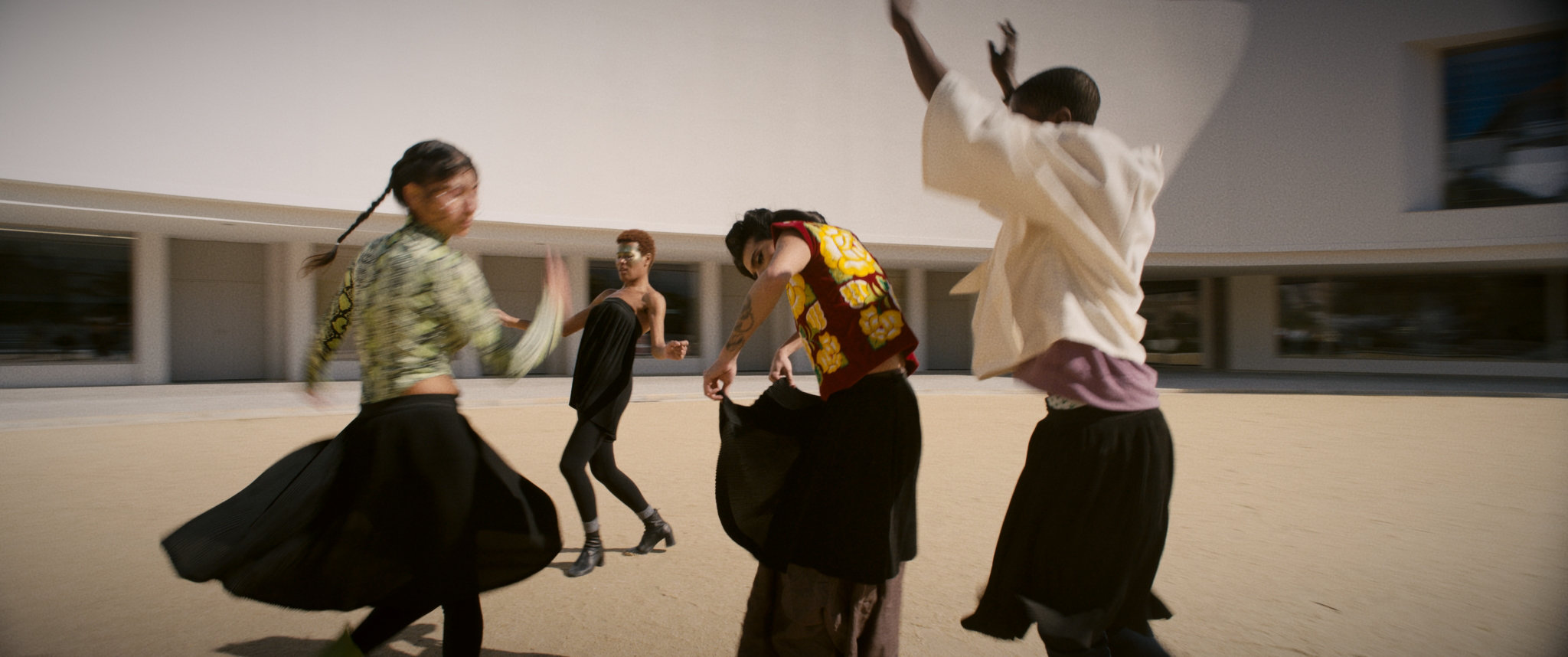
Still from Step With Me Into The Boundlessness, 2023. HD video. Vir Andres Hera.
Recalling the location of the work, they share how it was shot in Portugal, the edge of Europe and right on the Atlantic. This is valuable Vir imparts, noting how,
‘we are all people coming from colonised countries and for me being in this territory of Portugal is like being on the edge. Still in Europe, still a part, but almost not there. And we don’t know if we are arriving or leaving. It’s filled with history linked to slavery, and the American continent. But I also chose Portugal for its kitschiness and neoclassical style, reminiscent of that colourful style found in the architecture of Mexico, Martinique, or Peru, or in the mansions of South Florida or Louisiana. I wanted to play with what seems to be a precise geographical location, but isn’t really. There is something special, I really like Portugal for that. I like how in this case we were in a space where we came in as foreigners, in a place which was foreign to us also. It was a matter of getting to know the place, we were black and brown folks coming to this place. The reactions of the people we encountered… we were bringing a disrupting energy, and it was really beautiful also – we were sleeping in a really old hotel in this town and the hotel looks like something form the past but also it’s dreamy and beautiful, and us being there meant something. If the place was known to me a lot, I couldn’t play with it. If it’s familiar you cannot play with this [newness].’
We continue discussing this sentiment of newness, of being or creating somewhere unfamiliar. Vir speaks to how showing their work in a new space, at The Writers’ Room, extends the work – ‘it interests me to show it in the UK because Belinda Zhawi – whose voice is the narrator throughout the piece – is from there. She’s also from Zimbabwe but she has roots in the UK.’ Continuing to discuss the making of the film, they share Belinda’s role in the dialogue writing of the work;
‘she always works with text about her life and her experience of being a Zimbabwean and English woman, and she has this really amazing voice, like the voice of a healer. It’s almost frightening; it’s soothing too, but frightening in the sense of an ancient goddess, a voice with a lot of weight. Carving the image through her voice. Her English is informed by her experiences of being a Zimbabwean woman, so I really wanted someone who doesn’t come primarily from Europe, with a diaspora voice. The text we made together comes from gossip. We spent ten days in a studio in the middle of nowhere in France. I was doing a residency in rural France, in one of the country’s oldest Art Schools, in the city of Bourges. She came there – she’s used to this heavy metropolitan life in London, and I brought her to this really rural and almost empty space. I really wanted to have time to just tell her what happened during filming – we were calling the performers and they would give feedback of specific moments from the film, in the first days of being in the studio. Then after those first days, we would lock ourselves in the cabin and she would narrate her ‘souvenirs’ from the conversations had, the pieces she had gathered along each day’s call. She hadn’t been there for the filming so she never saw the visual work, her ‘image’ of the film was purely built through listening back to others retelling the work. The process was like ‘moving the image’, moving time and space in the recording room. I would say to Belinda, now tell me what the performers were saying when they were drinking coffee in bed, and she would say back what she could remember. What came was continuous speech, until the banal became charged with spirits . . . and the meaning of the sentences took on a temporality that was not that of the present.’
They continue, speaking of what it is to exercise memory.
‘It was challenging, and really tiring for her to remember everything, to repeat over and over and over again. I would ask what did she see, what did she feel. It’s this thing about distance, about how memory and bodies help you to go, not only to other ways of telling the story, but also to another time. It’s not always the present time, but also a time that can be set in the future or the past, which has to do with how we live queer time, or queer perception of time. Always moving, shifting, playful. Trans-temporal, trans-spatial. Playing with time and montage in the moving image, helps me think through my queer temporalities, through displacement. Living outside of the big cities, I’m privileged to be external to Capitalist time, to the time of the city, my queer time is extensive and I can spend all my time on my practice, and spend time then with my collaborators and friends. I come from Tlaxcala, the smallest state of Mexico – we both come from oral traditions. In the Western tradition in creating film you often have to have a script and write things precisely. In this film there was nothing written, just things being shared and those conversations then recollected. Here, the script came after the film work was done.
Everyone brought a bit of themselves, their clothing, makeup, objects, memories. Advice about how they wanted to shoot the scenes, to make the image. It’s collaborative. But it’s also problematic in that regard – when you work with people, you work with personality and ego, with sensibility, pain and trauma that people are bringing, because you ask them to work with their life experience and with their feelings. Sometimes it’s really hard. By saying we work in a collective way, and I like to question my own place, it’s not easy also for them. There can be imbalances in the work done and dynamics, especially if you’re working with friends and not [friends]. It’s a matter of boundaries, never solved completely. Collectivity and care – it can be amazing though, in this space of creating, I remember the energy I feel in the process of recording, you really feel it present. It’s something that stays. The film is, on that note, documenting the meeting of a group of people, and the inherent intimacies.’
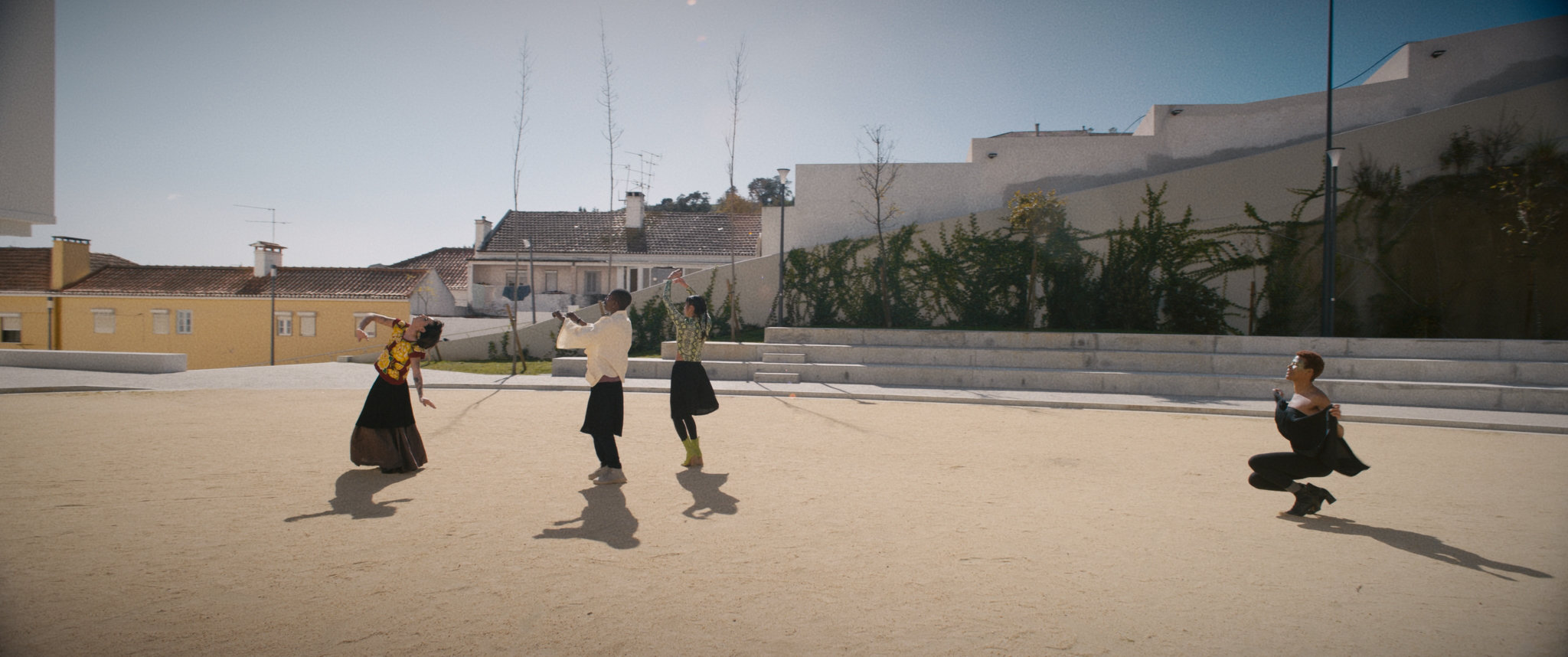
Still from Step With Me Into The Boundlessness, 2023. HD video. Vir Andres Hera.
When thinking about the texture and perspective in moving image, I think about inconsistencies – ideas that shift, turn, invert, rather than maintain uniformity. Such evolutions feel preoccupied with both the development of language as a sculptural and visual notion, coming out of sound, the body, utterance. Through remembered intimacies, Vir’s process of a narrative led by oral traditions evokes a dialogue formed through an exchange of touch and deep listening and sharing. Crossing personal narratives and pieces of history, their work makes words, voices and languages heard, that they associate with fragmented visual montages and enigmatic images – just as Rivers and Russell’s work utilises – as a reflection of the plurality of perspectives and realities.
I consider how neither of the films examined strictly have a plot – I could enter at any point, and in each case I feel as though I have joined the narrative a moment late, arriving mid act. Each film is full of narrative, though not in the traditional cinematic sense, but more with the notion that placing shots together creates narrative. This holds potential for instilling a dense of displacement, of the viewer (and subject) fathoming where they are stood among the motion, but via this fragmented way of looking focuses and holds attention and offers a much more truthful way of looking, without necessarily presenting resolution but showing things how they might well be, how subjects engage with other subjects, how small acts unfurl. There is a distance that distorts chronological flow perhaps, but isn’t separate from affective or even emotional responses, affects and emotions happening in conjunction with thinking through ideas. The films here feel like the contracting/ expanding embodiment of an idea that arrives through lived experience. A fragment of living offered, which we can choose to pass by or to embrace, to connect with.
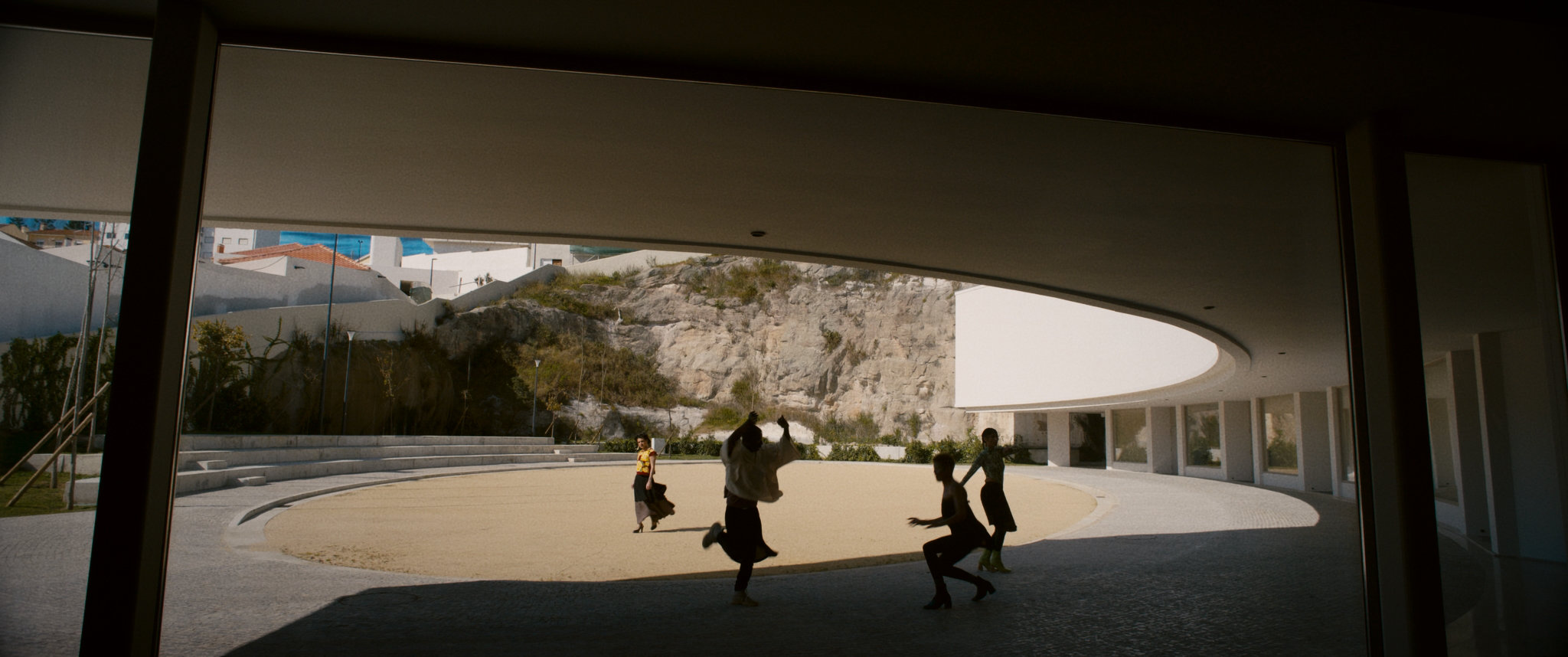
Still from Step With Me Into The Boundlessness, 2023. HD video. Vir Andres Hera.
Biography
><
Lu Rose Cunningham
Author
Lu Rose Cunningham